
Forest fire and succession on a raster#
Field: ecology · Zoo name: forest_fire · Module: modelly.zoo.forest_fire.model
A raster of cells, each empty, a tree, burning or burnt. At the start every cell holds a tree
with probability density, or with its own probability from a cover raster, and the trees
of the west edge are set alight. Every step a tree next to a burning cell (von Neumann
neighbourhood) catches fire and a burning cell burns out. With growth > 0 empty and burnt
cells grow a tree with that probability per step, and with lightning > 0 a tree is struck
with that probability per step: the Drossel-Schwabl model of succession and disturbance.
How it is written#
The state is one integer per cell, kept as a property layer of an OrthogonalVonNeumannGrid
(model.layer, shaped (width, height) like the grid; model.state is the same array
flattened in CellIndex row order). The spread is one sparse product per step,
CellIndex.neighbor_sum, over the grid’s adjacency, so a 100 x 100 fire runs in a fraction of
a second. A land-cover raster read with modelly.space.geo.RasterLayer gives the cover
directly: ForestScenario(cover=layer.values) (the geo extra is needed only for reading the
file, not for the model).
from modelly.zoo.forest_fire.model import ForestFire, ForestScenario

model = ForestFire(ForestScenario(rng=42, density=0.65))
model.run()  # stops when the fire is out
model.burnt_share(), model.spans()
model.datacollector.get_model_vars_dataframe()  # cells per state per step
Parameter |
Default |
Meaning |
|---|---|---|
|
|
raster size in cells |
|
|
probability that a cell starts with a tree |
|
|
per-cell tree probability, shape |
|
|
probability per step that an empty or burnt cell grows a tree |
|
|
probability per step that a tree is struck |
|
|
maximum run length of |
Validation#
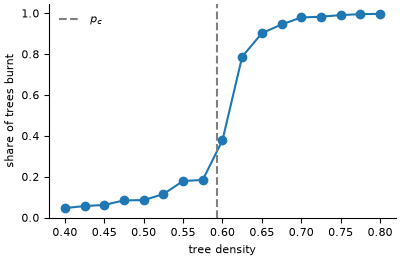
Without growth and lightning the fire burns exactly the clusters of trees connected to the
west edge, so the model is site percolation on the square lattice, whose threshold is
p_c = 0.592746 (Newman and Ziff). On a 100 x 100 raster the transition is about
L^(-3/4) ~ 0.03 wide.
tests/zoo/test_forest_fire.py checks, for three seeds, that at p_c - 0.15 the fire never
reaches the east edge and burns under 10 % of the trees, and that at p_c + 0.15 it always
reaches the east edge and burns over 90 %; that the mean burnt share rises with density; that
a cover raster confines the trees; that succession mode keeps burning and conserves cells; and
that the same seed gives the same fire.
References#
Drossel, B. and Schwabl, F. (1992). Self-organized critical forest-fire model. Physical Review Letters, 69(11), 1629-1632.
Newman, M. E. J. and Ziff, R. M. (2000). Efficient Monte Carlo algorithm and high-precision results for percolation. Physical Review Letters, 85(19), 4104-4107.
Stauffer, D. and Aharony, A. (1994). Introduction to Percolation Theory, 2nd ed. Taylor and Francis.
Start a project from it with modelly zoo copy forest_fire my_forest.