
Bouchaud-Mezard wealth condensation#
Field: economics · Zoo name: bouchaud_mezard · Module: modelly.zoo.bouchaud_mezard.model
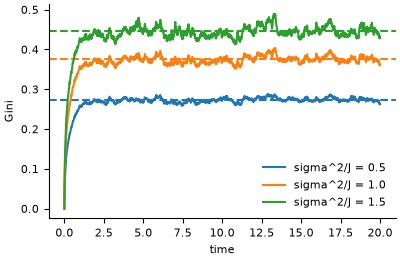
Each agent earns a random return on its wealth and exchanges with everybody else. In the
mean-field version, dW_i = J (mean(W) - W_i) dt + sigma W_i dB_i (Ito): returns of
variance sigma^2 per unit time, and an exchange that pulls each wealth toward the mean at
rate J. The more noise relative to exchange, the more the wealth condenses into a few hands.
How it is written#
Wealth is a Column on the Saver agent class. A step of length dt applies the
multiplicative part exactly, W <- W exp(sigma sqrt(dt) xi - sigma^2 dt / 2) (mean
preserving, never negative), then the exchange W <- W + J dt (mean(W) - W), then divides by
the mean, so model.wealth is wealth relative to the mean. Each part is one numpy expression
over the column.
from modelly.zoo.bouchaud_mezard.model import BouchaudMezard, BouchaudMezardScenario

model = BouchaudMezard(BouchaudMezardScenario(rng=42, volatility=1.0))
model.run()
model.stationary_shape()  # alpha = 1 + 2 J / sigma^2
model.datacollector.get_model_vars_dataframe()  # Gini per step
Parameter |
Default |
Meaning |
|---|---|---|
|
|
number of agents |
|
|
exchange rate |
|
|
|
|
|
step length; |
|
|
run length of |
Validation#
The Fokker-Planck equation of the relative wealth w has the stationary density
P(w) ~ exp(-(alpha - 1) / w) / w^(1 + alpha): an inverse-gamma law with shape
alpha = 1 + 2 J / sigma^2 and mean one, whose tail is a Pareto law of exponent alpha.
Bouchaud and Mezard write the noise variance as 2 sigma^2, hence their
mu = 1 + J / sigma^2.
tests/zoo/test_bouchaud_mezard.py runs 2,000 agents for ten relaxation times, then takes
twenty spaced snapshots, for sigma^2 / J = 0.5, 1 and 1.5 (shapes 5, 3 and 7/3, all of
finite variance) and two seeds. The mean Gini must be within three single-snapshot standard
deviations of the Gini of the inverse-gamma law, computed by quadrature of its Lorenz
identity G = 1 - int (1 - F)^2. Both the analytic and the simulated Gini must rise with
sigma^2 / J. It also checks that an unstable step length is rejected and that the same
seed gives the same run.
References#
Bouchaud, J.-P. and Mezard, M. (2000). Wealth condensation in a simple model of economy. Physica A, 282, 536-545.
Start a project from it with modelly zoo copy bouchaud_mezard my_economy.