
Individual-based population with energy budgets#
Field: ecology · Zoo name: energy_budget · Module: modelly.zoo.energy_budget.model
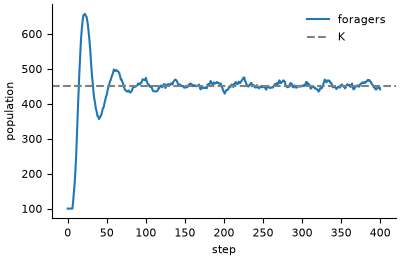
Foragers walk a grid on which a resource flows in at a constant rate per cell. Every step each
forager moves to a random neighbouring cell, the foragers in a cell share its resource equally
and turn it into energy with an assimilation efficiency, and each pays a metabolic cost. A
forager whose energy reaches birth_threshold splits it with an offspring in its cell; one
whose energy falls below zero starves. Nothing but energy regulates the population.
How it is written#
Foragers keep their energy and the row of their cell in Column arrays and are placed by row
(CellIndex.track), so no cell keeps a list of agents. Moving is
CellIndex.random_neighbor, sharing is CellIndex.counts, starving is
ColumnTable.remove_where; only births create objects (ColumnTable.do_where).
from modelly.zoo.energy_budget.model import EnergyBudget, EnergyScenario

model = EnergyBudget(EnergyScenario(rng=42))
model.run()
model.population(), model.carrying_capacity()
model.datacollector.get_model_vars_dataframe()  # foragers and uneaten resource per step
Parameter |
Default |
Meaning |
|---|---|---|
|
|
grid size in cells |
|
|
foragers at the start |
|
|
energy of each initial forager |
|
|
resource added to every cell per step |
|
|
share of the eaten resource turned into energy |
|
|
energy spent per forager per step |
|
|
energy at which a forager splits with an offspring |
|
|
run length of |
Validation#
The resource is never capped and is eaten whenever a forager visits, so in the long run all of
it is eaten. At equilibrium the energy assimilated equals the energy spent,
efficiency * inflow * cells = cost * N, which gives the carrying capacity
K = efficiency * inflow * cells / cost (450 with the defaults). The only other energy leaving
the balance is the deficit of starving foragers, at most one cost each, which keeps the mean
population at or slightly above K.
tests/zoo/test_energy_budget.py checks, for three seeds and two inflows, that the mean
population after a burn-in of 150 steps is within 3 % of K (the step-to-step fluctuation is
about 2 % of K, and averaging 250 steps leaves well under 1 %); that the uneaten stock stays
bounded; that the population dies out without inflow; and that the same seed gives the same
population curve.
References#
Grimm, V. and Railsback, S. F. (2005). Individual-based Modeling and Ecology. Princeton University Press.
Start a project from it with modelly zoo copy energy_budget my_population.