
Deffuant bounded-confidence opinion dynamics#
Field: sociology · Zoo name: deffuant · Module: modelly.zoo.deffuant.model
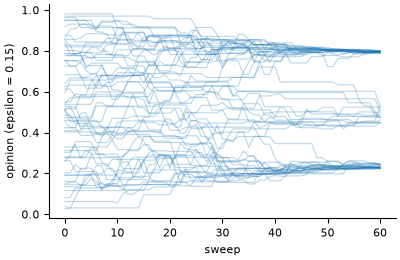
Every agent holds an opinion in [0, 1]. Two agents who meet compromise only when their
opinions differ by less than the confidence bound epsilon: each moves a share mu of the
difference towards the other. A wide bound ends in consensus; a narrow one freezes the
population into clusters, about floor(1 / (2 epsilon)) of them for uniform initial opinions.
How it is written#
Opinions are a Column of the Voter agents, so the whole population is one numpy array.
The original model meets one random pair per time step; here one step is a sweep: a uniformly
random perfect matching (a permutation cut into consecutive pairs), and every pair closer than
epsilon compromises at once from the start-of-step opinions. The pairs are disjoint, so the
updates never interfere, and each agent meets one uniformly random partner per step. A step
is therefore about n / 2 events of the original model, with the same absorbing states:
clusters further than epsilon apart.
from modelly.zoo.deffuant.model import Deffuant, DeffuantScenario

model = Deffuant(DeffuantScenario(rng=42, epsilon=0.1))
model.run()
model.n_clusters()
model.datacollector.get_model_vars_dataframe()  # clusters and spread per step
Parameter |
Default |
Meaning |
|---|---|---|
|
|
number of agents |
|
|
confidence bound |
|
|
share of the difference each partner moves |
|
|
clusters smaller than this share are not counted |
|
|
run length of |
Validation#
tests/zoo/test_deffuant.py checks, with three seeds, that epsilon = 0.4 ends in one
cluster, that epsilon = 0.1 leaves floor(1 / (2 epsilon)) = 5 clusters plus or minus two
(run-to-run fluctuations of the published rule of thumb), and that the mean cluster count does
not grow over the sweep epsilon = 0.05, 0.1, 0.2, 0.4. It also checks that the mean opinion
is conserved by every compromise, that epsilon = 0 freezes the opinions, and that the same
seed gives the same run.
References#
Deffuant, G., Neau, D., Amblard, F. and Weisbuch, G. (2000). Mixing beliefs among interacting agents. Advances in Complex Systems, 3, 87-98.
Start a project from it with modelly zoo copy deffuant my_opinions.