Case study
OpenPlod
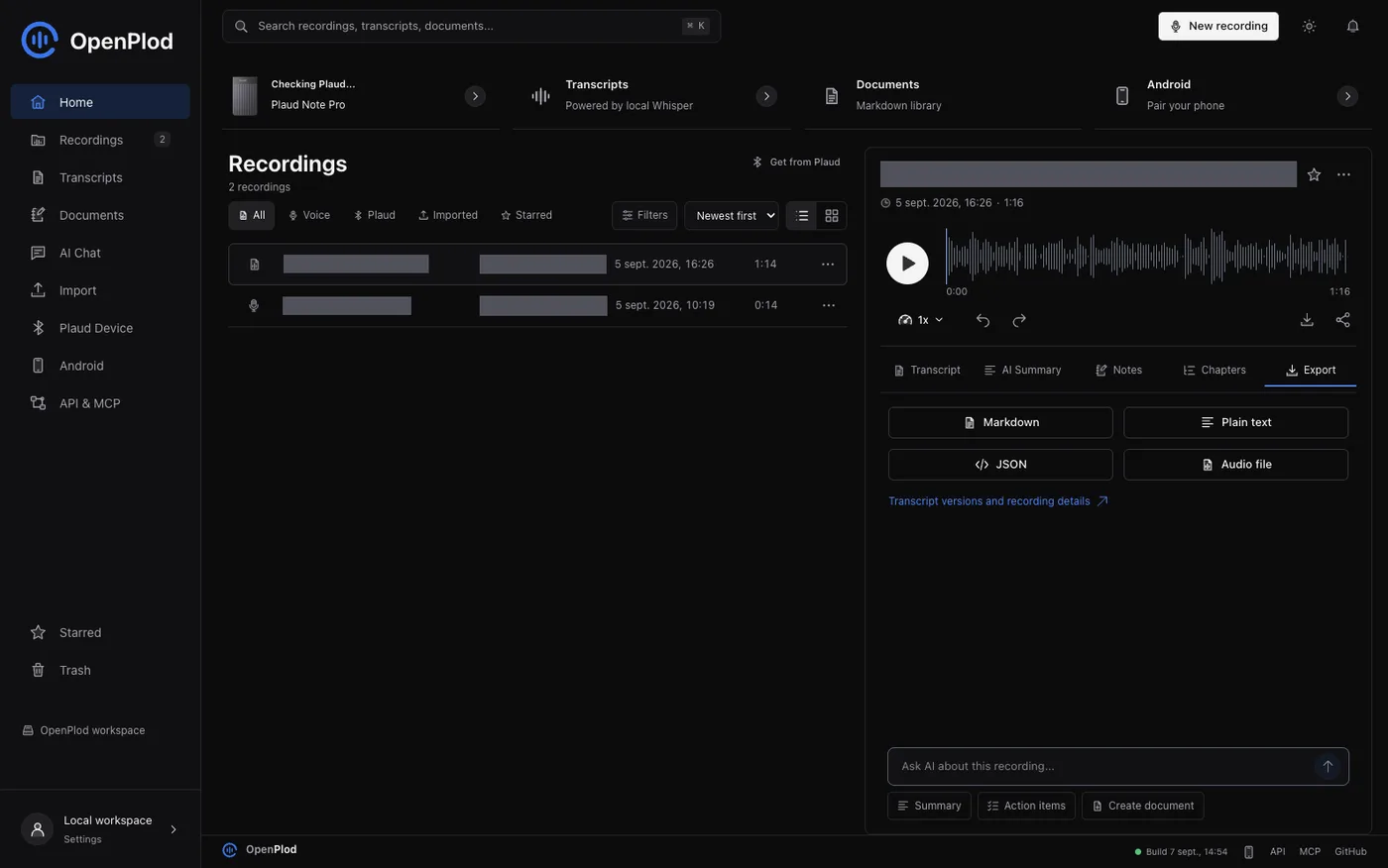
A desktop app that pulls recordings off a Plaud Note Pro over Bluetooth, keeps them in a vault on your computer, and turns them into transcripts and Markdown documents.
- Role
- Author and maintainer
- Stack
- Tauri, React, TypeScript, SQLite
- Release
- 1.0.0, 39 stars
- Platforms
- macOS, Linux, Windows, Android companion
Problem
A voice recorder is only useful if you can get the audio out and work with it. OpenPlod keeps the recording, the transcript and the document on your own machine, and lets you pick who transcribes them.
What I built
- Direct Bluetooth import from the recorder, with the session left intact on the device.
- Transcription with Mistral, local whisper.cpp, Deepgram, OpenAI or AssemblyAI. A failed job never deletes the recording.
- Documents generated from a transcript as structured notes, meeting minutes or a project brief, in Markdown, with version history.
- A versioned REST API and an MCP server that is read-only unless you switch writing on.
- An Android companion that pairs by QR code and keeps its copy until the desktop confirms storage.
How it works
The desktop app owns the vault: a SQLite database and the audio files. Every client, including the phone and the MCP server, goes through the backend API and never opens the database itself. Audio, transcript and document are three separate resources, so editing a document cannot rewrite its source.
Limits
Bluetooth extraction is verified on one authorised Note Pro. The Windows bridge builds but is not verified on hardware. iOS cannot talk to the device. The Mac build is ad-hoc signed and not notarized, and the app does not encrypt the vault itself.